On June 11, 1970 Anna Mae Hays and Elizabeth Hoisington were the first women in the U.S. military to be promoted to Brigadier General.
Yesterday, Pete Hegseth removed all women from the promotions lists. He also decided that some men had too much melanin and took them off the list, too, but it wasn't every man of color who was removed.
If you grew up in the military, if you know a veteran -- especially if it's a female veteran -- call, write, or email their congressperson and your own. Bonus points if the congress critter is on one of the armed services committees. [ https://www.armed-services.senate.gov/ lists the senate committee, https://armedservices.house.gov/about/members.htm lists the house committee members]
After 28.5 years in the Army, my father retired and became a professor. Many of the kids he taught were ROTC -- as he had been -- and a large percentage went into the regular military rather than the reserves. About eight months before he died, we got a letter from one of his students who had just retired as a Rear Admiral thanking him for his guidance and example. Dad was so proud of this woman. When he entered the service, most WACS and WAVES were nurses or secretaries. Now, he was being honored by a student who had been promoted to a higher rank than he'd held for her work in Computer Systems.
Several years before her promotion, when I was five, I was privileged to meet Colonel Hoisington. I swear I heard Dad's spine snap as she was introduced to us by a mutual friend. On our way home that evening, he told me to remember her because it was predicted that she'd be the first woman general.
As a sample, I would like to suggest:
It is appalling that a Secretary of Defense has removed all women and many men of color from the Naval promotions list. At a time when we have hotspots around the world, it is crippling to morale to see that hard work and honorable service has been deemed unworthy of further advancement. Nurses, doctors, logistical and other support personnel are as essential to our ability to operate as helicopter pilots or gunners. Good officers should be promoted.
If you or the veterans you know have any personal story to share, please do so.
I grew up in the military. I hate what's being done by our current president in the Middle East, Venezuela, and, potentially, Cuba. But that doesn't mean that I don't value military service. It's time that Congress demonstrated that it, too, values the voluntary service of our military.
Books Since last I posted one of these, of course I read Ann Leckie's Radiant Star. I loved it. Leckie's doing something different with narrative voice this time around, so mark that off your bingo card, and if you enjoy Victorian novels then this narrator might be particularly enjoyable for you. It goes very hard.
Having read that (and then a friend's annotations, which I then sent on with the ARC to the next person in the chain) I decided I wanted to take some space to recover with T Kingfisher's fourth paladin book, Paladin's Faith. Which, as it turns out, is going much harder than I expected it too.
I am also making my way slowly through Nick Walker's Neuroqueer Heresies, and finding it unsatisfying. I'd be less critical of it as polemic (although still annoyed at the prescriptivism and the exhorting readers to police other people's language too if they don't use "neurodivergent" and "neurodiversity" according to Dr Walker's preferred definitions), but when she's stating outright in the book that she intends to use it as a textbook to teach in university, I want more rigour and citations.
Fandom Enjoying a resurgence of Radch discussion on Discord.
More ephemeral fic in the Nine Worlds fandom. May was good for that.
Crafts Finished the table.
Tech Wayland and gnashing of teeth. That said, I learned how to use xargs in Bash, which made Android backups easier for me.
Garden Harvested what is, amazingly, not the last of the tomatoes. Semi-dried all the ripe tomatoes I had in the oven, and froze the results. Did a little weeding, and sowed pak choy and calendula seeds.
Cats They don't like the cold weather, but Mighty Hunting continues.
The Witness, a limited series (3 episodes) is available now on Netflix. It's about the 1992 brutal stabbing of Rachel Nickell while walking on Wimbledon Common during the day with her two-year-old son, Alex.
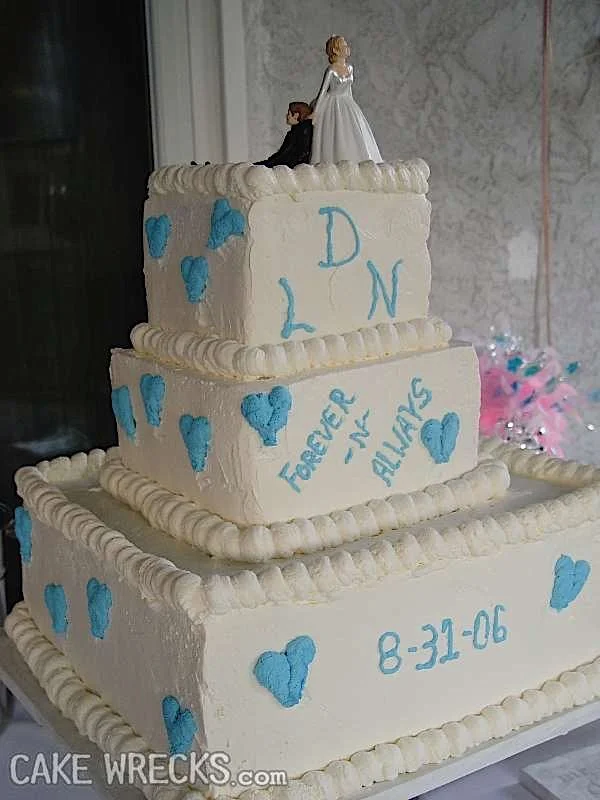
You ever see a cake and have one of those reactions like: "Ooooh, that's not good. I mean, it could be worse, I guess, but still, really not good. What was it for? ... A wedding?! OH THAT POOR BRIDE."
That's today's cakes.
They're all a bit sad...
A bit lumpy-bumpy...
A bit, "Oh. OH. Um, how... nice?"
When your wedding's "cupcake tower" looks like something you made during the slumber party for your 14th birthday:
Or when there's more wire in your wedding cake than the average 14-year-old's braces:
o.0
You know how in movies when the bad guy lets loose with a machine gun on a wall somewhere, leaving lines of bullet holes that the light shines through?
Imagine the gun shoots roses:
BAM.
(Yes, I know otherwise it's fine. JUST LET ME HAVE THIS.)
And finally, whatever you do, don't think about stretched skin.
Or parsley.
STOP IT.
Thanks to Carrie B., Deanna H., Jimena, Dawn D., Shannon, Britton E., Helen, & Pat J. for lifting our saggy, saggy spirits.
*****
P.S. Speaking of ways to prevent sagging (oh yeah, nailed that segue), this saved my butt during a long painting day recently, so I have a random product recommendation:
This is my new favorite belt, y'all. It basically turns anything with belt loops into an elastic waist. So comfy I forget it's on, slimline so it doesn't show under my t-shirts, and NO BELT BUCKLE to dig into my belly or unbuckle for bathroom breaks. Woohoo!
You know how stretch jeans are forever sliding down when you sit or bend, so you have to keep hitching them back up? No more! I wear this with all my jeans now. It's entirely elastic, so it moves and stretches with you, zero painful digging. I HIGHLY recommend for anyone well endowed with squish in the belly area.
Some years ago I advised a composer who was composing an opera about A Historical Figure about whom I am something of a Nexpert, and I am now on their mailing list and get info on their current activities and broadcasts and so on -
And I was invited to the Private View of this, taking place at a venue which is only a reasonable bus-ride and short walk away.
Also giving me the chance to see a small part of the nearish locality with which I am relatively unfamiliar, and which has its charms.
I am not sure I was entirely enthused by the artworks - there was one installation of ceramics where I wished I had someone there to whom I could murmur that they had an urgent phallic look -
My main problem with the venue, however, was the acoustics - I think it was the kind of space where once you got a certain mass of people conversing it would always have been a bit trying for me and my hearing aids, but combined with the ambient music coming out of the various speakers, not optimal at all. (Though maybe its own soundscape....)
I don't think there was anyone there I knew besides The Composer - mostly of a younger generation and art/music people rather than groves of academe - and I didn't really get into much chat, but I did get 2 admiring comments on the green hair streaks and 1 compliment to my pendant (which I think I got at Wiscon, unless it was 4th St?).
However, I have had a sweet email from The Composer thanking me for coming.
It’s the return of Ayla’s backyard bunny cam! This time, meet the Blueberry Goblin! Thanks, Ayla!
[Ed. note: Longtime bunny friends know this already, but please do give your buns fruit in moderation; too much can be hard on those delicate bellies.]
Mickey Barnes and Timo join an expedition to the planet Niflheim, hoping to outrun a murderous loan-shark. The hapless Mickey signs up as an "Expendable", not realising this means he will have his memories uploaded to a computer and then be made to do all sorts of hazardous work, getting cloned/printed afresh every time he dies. He rapidly makes his way up to Mickey 17 before being abandoned in an ice ravine...
The expedition is led by a feeble but egotistical white supremacist whose followers (who make up a sizeable chunk of the expedition crew) wear red hats; and that is about as subtle as the politics of this film gets. It has a number of Points To Make, and it does so with some vigour.
A bunch of the plot doesn't hold up if you look at it hard ( spoilers ), and sometimes the plot was deeply predictable ( spoilers ). There were bits that were too cringey for me, but I have abnormally low tolerance for cringe.
But I think my main problem with Mickey 17 was that I didn't find myself caring about the plot very much - something about the whole thing kept breaking my suspension of disbelief, and I found myself thinking "this is a very silly movie" rather than getting caught up in what was happening. Possibly because too many of the characters' choices seemed inexplicable? Anyhow, my least liked of the Hugo films this year so far (and there's only 1 left).
We might not have spent the sunset at Marblehead Light if we had known that all five yacht clubs within earshot would fire off a salute of cannons in accordance with the naval tradition of evening colors in season, but on either side of the sudden harbor-rolling cracks of smoke it was a postcard of a sunset in the smelted oranges and wave-mirrored blues of a painted present from, partitioned by the nineteenth-century cast-iron skeleton of the light itself. spatch had wanted to take me to water after I had spent the previous day in the kind of pain where as soon as it eased off a little I passed out. We ate roast beef sandwiches parked at the Mystic Lakes and drove north once rush hour had died down.
Home again with a bowl of noodles, I heard rushthatspeaks' irresistible report on Tokuzō Tanaka's The Whale God (鯨神, 1962), a radiation of Melville I had known nothing about. Rob and I have not yet caught up on the latest episode of Widow's Bay (2026), but last week when we marathoned the previous three we were delighted to confirm that in its remix of New England horrors, Shirley Jackson had unambiguously entered the chat. Hestia, our own lighthouse, was golden-eyed in the cat tree.
Current Music:Goblin Band, "The Prickle Holly Bush"
Wow, I read a lot of books in May. However, most of them were short, so it's actually not like I read more than I normally do. It just seems that way.
Mann, Thomas: Death in Venice. Penguin. 1991 After Buddenbrooks, this was my second Mann. It was not as addictive as Buddenbrooks, but certainly still a very good novella. I feel like Mann is so very good at describing the "summer vibe" - that very distinct feeling when you're on vacation and time seems somehow suspended. He does that both in Buddenbrooks and in Death in Venice. I've never seen that particular feeling described anywhere else so poignantly.
Taylor, Peter: A Summons to Memphis. Vintage. 1999. Not a very successful outing as I felt I should have gotten more out of this book than I actually did. There is lot going on under the surface, but somehow I didn't connect with that subtext.
DeLillo, Don: The Silence. Scribner. 2020. Mhm, no. This is only 100 pages long and tries to be philosophical and dystopian, but it never spends enough time with any of the many topics and themes that get mentioned to feel in any way rewarding. And the dialogues were just ... baaaaaad. Oh, my.
Richardson, Kim Michele: The Book Woman of Troublesome Creek. Sourcebook Landmarks. 2019. After Jojo Moyes' The Bringer of Stars my second novel about the Kentucky Pack Horse Library, which is an absolutely fascinating topic, but apparently no one is able to put that into a good novel. Any Americans here who could recommend something worthwhile on the subject of the Pack Horse Library? Is there a good non-fiction book where I could learn more about it? Novels don't seem to cut it.
Kopetzky, Steffen: Damenopfer. Rowohlt. 2023 (German) Kopetzky writes interesting historical novels that are a little off the beaten path. This one is about an actual historical figure (Larissa Reissner), but most importantly it's about the cultural and political shift in Europe (Soviet Russia and Germany in particular) that took place in the 1920s. Very interesting if you like a good panorama - lots of name-dropping from Stalin to Nabokov included!
Lewis, Herbert Clyde: Gentleman Overboard. Boiler Press. 2021. This was the highlight of the month, I enjoyed this a lot! It's a short novel about a gentleman (that detail is important) who goes on a sea voyage and falls off the ship. Instead of screaming for help he decides instead to not inconvenience anyone. Things will sort themselves out ... yeah, sure. This was half satire, half psychoanalysis. And the authorial voice was to-die-for.
Forster, E. M.: The Longest Journey. Penguin. 2006. Apperently, this was Forster's favourite amongst his novels. However, it feels a bit disjointed and never turned into a cohesive narrative for me. It had strong moments and scenes, but it smelled a little of Hardy to me in the sense that the plot was so terribly ill-fated. But again: Forster has a knack for really strong endings!
Mina, Denise: Rizzio. Polygon. 2021. Not worth your time if you have even a passing knowledge of the Mary Stuart and Rizzio story. Denise Mina doesn't add anything new (apart from alluding to something going on between Rizzio and Darnley, because apparently we can't do without a queer angle nowadays). This read like barely fictionalised non-fiction. Or it read like gapfiller fanfic from someone just starting out in a fandom and trying something safe. Forgettable.
Brautigan, Richard: The Hawkline Monster. Canongate. 2017. Absurd and funny. Quite possibly written while the author was either drunk or high or even both. But I was amused and laughed out loud several times, so that was a win. Also, it's short and therefore doesn't overstay its welcome. (Always a problem with humour - oftentimes it simply goes on for too long, which sucks the fun out of it.)
I realized this week, while waiting, that a while-waiting project is still needed---something that could indeed drag on for months unhindered, but also, something that needs only one active skein of yarn and few or no instructions. (Not a cardigan-puzzle, and not the MKAL wrap.)
The sloppy handspun that was a tourist-traveler gift is too uneven to suit Lille Kolding. The WIP is, or was, awkwardly dense with the needle size I was using, and if sized up, it'd become too floppy in Kolding's brioche section.
Now that the most recent bout of waiting has led to completion of a Grainwise, I think that the pattern's mostly garter-stitch construction might forgive the handspun's unevenness. It's written for MCN (merino-cashmere-nylon) and I've used a wool-silk blend, but it's fine if the handspun isn't transformed into something swish. It should just become something other than a felted lump or, like, compost.
Also, Lille Kolding is more boring than Grainwise to knit, for me---how the design is put together, not what the finished product looks like.
This type of thing is why we need thoughtfulness regarding diversity in all domains, not only knitting design, where it isn't really crucial. In other words, it's great that many different scarf/shawl patterns exist.
Pushing myself through making one Lille Kolding was okay. The process of it nixed my willingness to plod through Architexture, which was meant as a while-waiting project, sat for months, and then was undone last month. Several knitters have commented on Rav that it's soothing and rhythmic. For me it just feels tedious, and given that I must listen closely sometimes while waiting, any project had better not put me to sleep. I imagine that some knitters would find Grainwise boring or tedious instead.
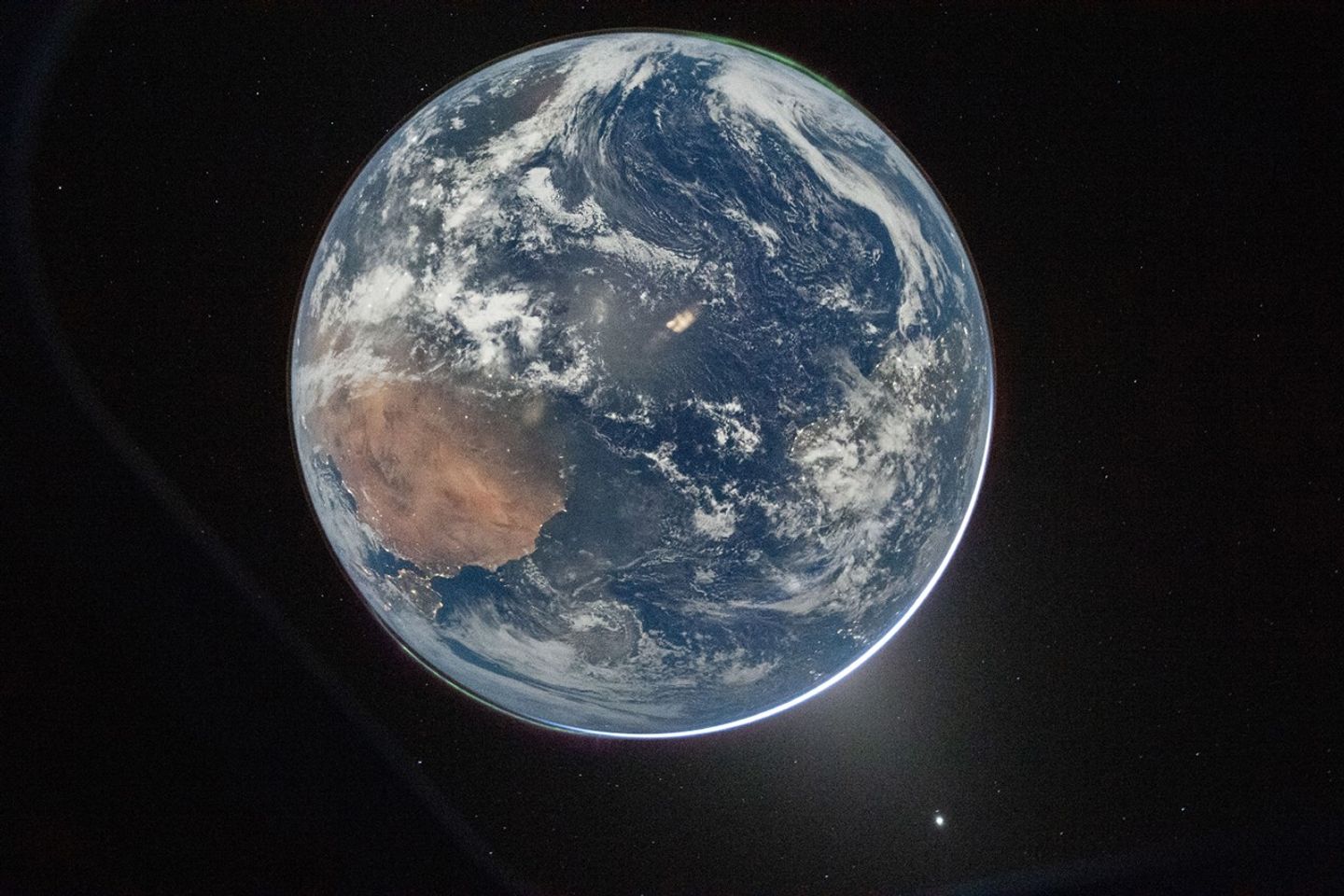
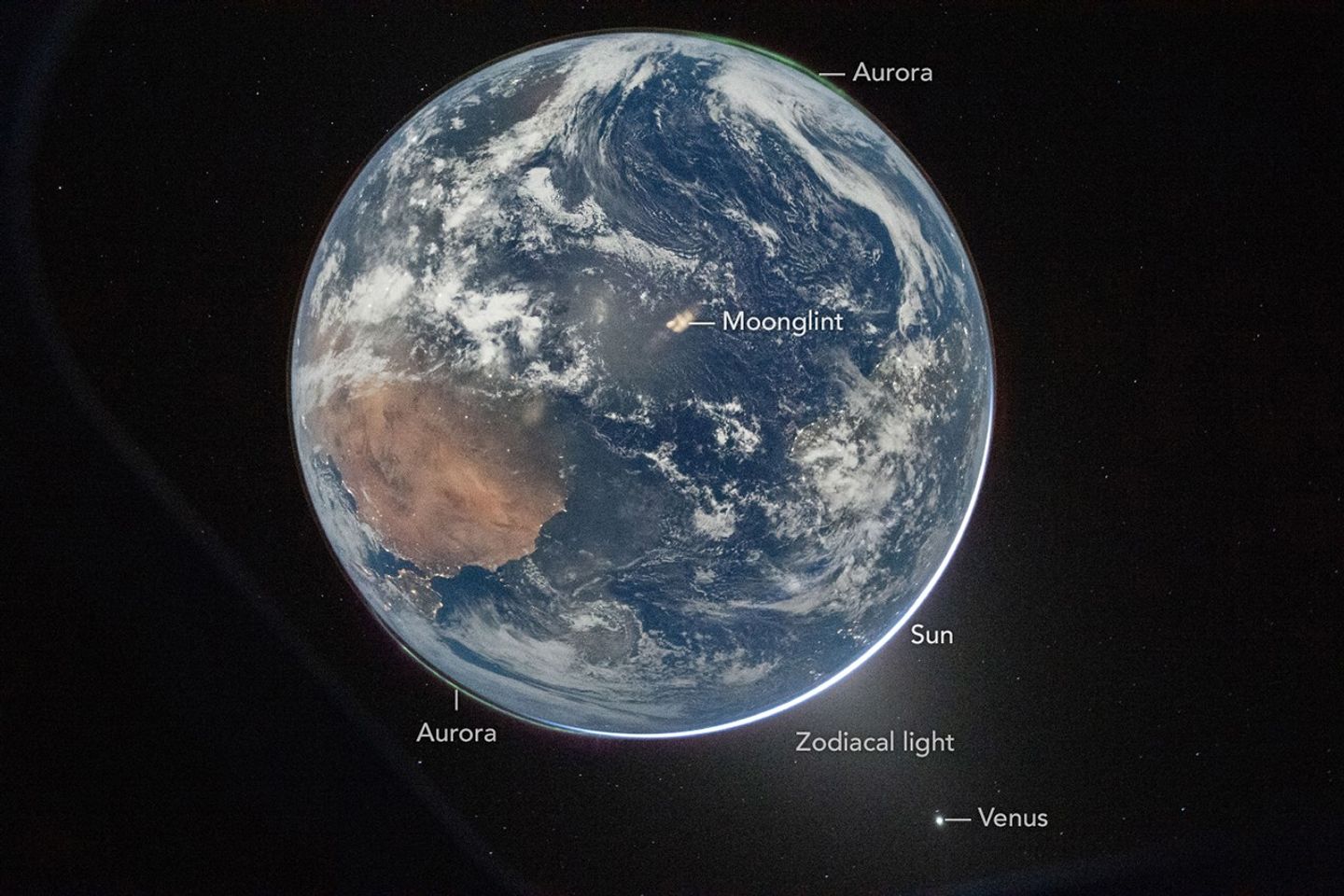
One of the first images transmitted back to Earth from the Artemis II mission was a stunner. In a single image, Earth’s full disk appears amid celestial phenomena that illustrate its place in the solar system. And although the visible hemisphere appears to be awash in sunlight, it is actually lit by moonlight. The astronauts’ vantage point provided a rare opportunity to capture nighttime features—most notably lights from human habitation—from a new perspective.
An Artemis crew member captured the photo from the Orion spacecraft after it completed the translunar injection burn, which sent the spacecraft out of Earth orbit and on a trajectory toward the Moon. In the photo, Earth eclipses the Sun from Orion’s perspective, leaving only a small sliver of its bright light visible around the bottom right edge. Green auroras, caused by charged particles from the Sun interacting with Earth’s upper atmosphere, glow around the north and south poles (lower left and upper right, respectively).
The Sun’s light also produces the fuzzy glow, known as zodiacal light, that appears to the lower right of Earth. This phenomenon comes from sunlight reflecting off interplanetary dust. Skywatchers on Earth may see it at certain times of year around dawn or dusk as a faint column of light extending up from the horizon. Data collected by NASA’s Juno spacecraft on its journey to Jupiter suggest that Mars may be a significant source of the dust particles that produce zodiacal light. Earth’s other planetary neighbor, Venus, appears as the bright object in the bottom right of the image.
April 2, 2026
On Earth itself, city lights are evidence of human activity. Bright areas appear in Spain, Portugal, and northern Africa (lower left), sub-Saharan Africa (center left), and Brazil (center right). Digital camera technology—with help from the illumination of a full Moon—made it possible to see these and other details of Earth’s surface and atmosphere in low light. The crew set the camera’s ISO to 51,200 to make it highly sensitive to light. For comparison, an ISO setting of 100 or 200 is common for daytime photography.
Previous nighttime views of Earth taken from spacecraft may look very different from this photo but have also inspired and enlightened. For instance, the Apollo 12 crew photographed Earth eclipsing the Sun in 1969; astronaut Alan Bean would go on to depict his impressions of the event in paintings.
More recently, astronauts aboard the International Space Station have photographed the planet at night from low Earth orbit, while NASA’s Black Marble nighttime lights product suite uses satellite observations to produce science-quality records of nighttime lights at daily, monthly, and yearly time scales. Those programs provide sustained data records, while the Artemis II photo is distinctive as a single human-captured full-disk view showing many low-light features at once.
Cindy Evans, senior exploration scientist in the Astromaterials Research and Exploration Science Division at NASA’s Johnson Space Center, was working in the Science Evaluation Room during the Artemis II mission and was one of the first people on Earth to see the image. Evans was struck both by its beauty and the perspective revealed by all the visible solar system features. “I love the image so much because it was taken with Earth in moonshine, and shows Earth as a solar system body, a dynamic planet interacting with the solar wind, and a place harboring life,” she said.
The image is scientifically valuable, as well, said Miguel Román, Deputy Director for Atmospheres and Data Systems at NASA’s Goddard Space Flight Center. “It speaks powerfully to the breadth of what NASA does across science and human exploration,” he said. Román studies artificial light at night, as viewed from space, as a measurable signal of human activity.
“[This photo] reminds us that Earth at night is visually compelling, physically complex, and scientifically underexplored,” Román said. “I see this image as a glimpse of what Earth science can become in the future.”
NASA images prepared for Earth Observatory by Lauren Dauphin. Story by Lindsey Doermann.
![[personal profile]](https://www.dreamwidth.org/img/silk/identity/user.png) fabrisse
fabrisse![[community profile]](https://www.dreamwidth.org/img/silk/identity/community.png)
![[syndicated profile]](https://www.dreamwidth.org/img/silk/identity/feed.png)