Mushroom walk
Oct. 3rd, 2005 03:30 pm![[personal profile]](https://www.dreamwidth.org/img/silk/identity/user.png) magid
magidYesterday I went on a mushroom walk led by Lawrence Millman (organized by the CCAE), out in Concord. (Larry's an interesting guy, whose real specialty is ethno-mycology, how Natives use mushrooms (especially in Canada, because he's an Arctic traveler). He travels, he writes freelance, he researches. Very cool. I'd definitely take another class with him.)
I learned a lot, though mostly how much I don't know. Some of it is vocabulary, like polypore, resupinate, and umbo. Mostly it's that I'm a mushroom novice.
After the group gathered, there was a bit of an intro period, where he talked about the glorious (for us), awful (for mushrooms) weather we've been having, and how that meant it was less likely we'd find lots. We did, though, apparently more than the walk the day before (in the same area).
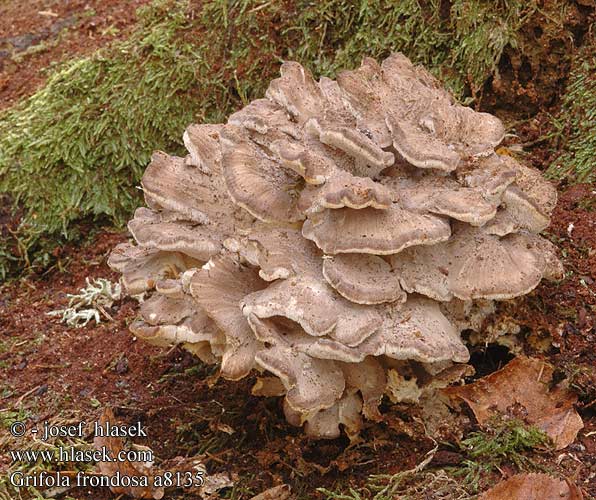
First up was a big hen of the woods that had been found yesterday, and left for us intentionally. It was big: all of us (16 people) got a nice size piece after he'd cut it off the tree stump and we'd looked at it, checking out the gills, how it grew on the tree (most of the mushrooms we found were on trees, because it's been so dry, and rotting trees hold the moisture longer), and learning that one should cook almost all wild mushrooms before eating. I was happy to have something to put in my basket (it turned out to be the only mushroom in my basket at the end, because I was only interested in bringing home edible ones, and most of what we found wasn't).
After that, we started paying more attention to the ground, to rotting trees, to stumps. It's amazing how many fungi are out there (lichen also). And Larry is enthusiastic about all of them. I started paying more attention to detail: density of gills, if there are gills at all (some have pores); talk about what colors the spores are (not related to other colors of the mushroom); how they attach to the tree (sessile) or the ground; whether they cluster or not; what kind of tree they're growing on, and so on.
We saw white, tan, yellow, orange, red, purple (!), brown, and black fungi, almost the whole rainbow. Most are reasonably ordinary:
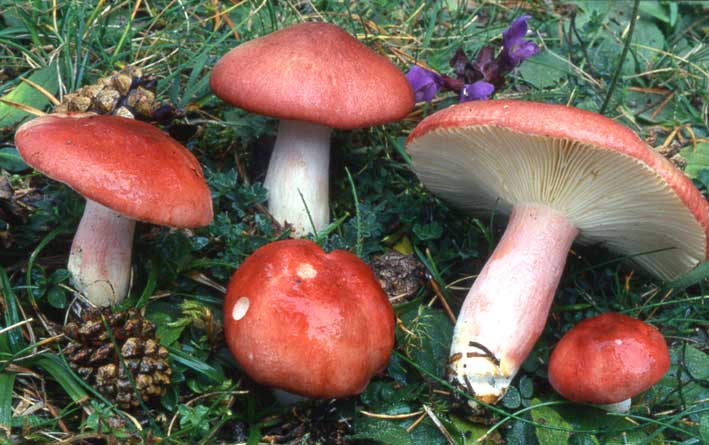
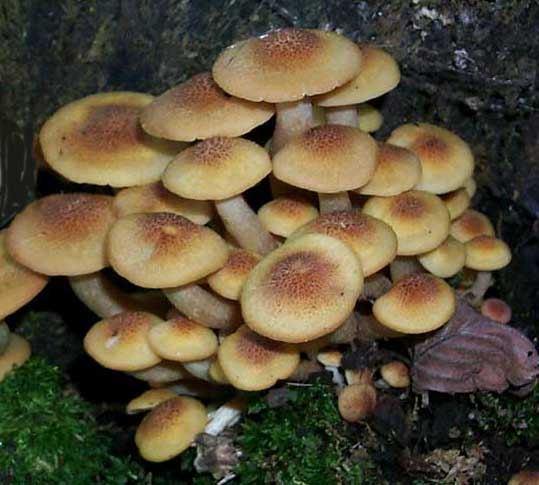
turkey tail, russulas, honey mushrooms, gymnopilus, puffballs (they really do puff!), purple-inside puffballs that are poisonous, amanitas, some kind of mushroom used for dyeing yellow that Larry collected for a dyer friend of his, and
stink horn. Interestingly, stink horns aren't in season, yet someone found some anyway. They're the only mushroom that springs up from an undereground egg (the whole thing, taken out of the ground, looks very much like a peeled banana, and has a pungent smell). We (well, not me) dug around the log and found stink horn eggs (they really look like eggs, too), the nascent stalk of the mushroom is what's eaten. I tried a little piece, and it tastes a bit like sprouts, or mild radish. Oh, and there was a kind of little cylindrical cup with little white 'sesame seeds' in them, that spring up and out when a drop of water falls on them.
The most rare fungus award: to the woman who found a camarops petersii: they've been found in only four locations, and have no common name; no one knows much about them. Larry took it to send to another expert friend of his.
The prettiest micro-landscape award: for the pine cone covered in little fairy mushrooms, which had little caps on slender tall stalks (think enoki). I wish it hadn't been too dark to take a picture then.
Random information: most of the 20-odd people who die of eating mushrooms in the US each year are immigrants who ate mushrooms that looked like something from home. British Columbia is a mycological heaven. And there's a Boston Mycological Club. Oh, and mushrooms have chitin in them, like in beetle shells. Weird.
I'm sure I'm forgetting things, too. It was a lovely walk.
Note to self: consider bug spray next time. Also bring water and snacks.
Other wildlife noted: dragonflies, chipmunks, a toad.
I learned a lot, though mostly how much I don't know. Some of it is vocabulary, like polypore, resupinate, and umbo. Mostly it's that I'm a mushroom novice.
After the group gathered, there was a bit of an intro period, where he talked about the glorious (for us), awful (for mushrooms) weather we've been having, and how that meant it was less likely we'd find lots. We did, though, apparently more than the walk the day before (in the same area).
First up was a big hen of the woods that had been found yesterday, and left for us intentionally. It was big: all of us (16 people) got a nice size piece after he'd cut it off the tree stump and we'd looked at it, checking out the gills, how it grew on the tree (most of the mushrooms we found were on trees, because it's been so dry, and rotting trees hold the moisture longer), and learning that one should cook almost all wild mushrooms before eating. I was happy to have something to put in my basket (it turned out to be the only mushroom in my basket at the end, because I was only interested in bringing home edible ones, and most of what we found wasn't).
After that, we started paying more attention to the ground, to rotting trees, to stumps. It's amazing how many fungi are out there (lichen also). And Larry is enthusiastic about all of them. I started paying more attention to detail: density of gills, if there are gills at all (some have pores); talk about what colors the spores are (not related to other colors of the mushroom); how they attach to the tree (sessile) or the ground; whether they cluster or not; what kind of tree they're growing on, and so on.
We saw white, tan, yellow, orange, red, purple (!), brown, and black fungi, almost the whole rainbow. Most are reasonably ordinary:
turkey tail, russulas, honey mushrooms, gymnopilus, puffballs (they really do puff!), purple-inside puffballs that are poisonous, amanitas, some kind of mushroom used for dyeing yellow that Larry collected for a dyer friend of his, and
stink horn. Interestingly, stink horns aren't in season, yet someone found some anyway. They're the only mushroom that springs up from an undereground egg (the whole thing, taken out of the ground, looks very much like a peeled banana, and has a pungent smell). We (well, not me) dug around the log and found stink horn eggs (they really look like eggs, too), the nascent stalk of the mushroom is what's eaten. I tried a little piece, and it tastes a bit like sprouts, or mild radish. Oh, and there was a kind of little cylindrical cup with little white 'sesame seeds' in them, that spring up and out when a drop of water falls on them.
The most rare fungus award: to the woman who found a camarops petersii: they've been found in only four locations, and have no common name; no one knows much about them. Larry took it to send to another expert friend of his.
The prettiest micro-landscape award: for the pine cone covered in little fairy mushrooms, which had little caps on slender tall stalks (think enoki). I wish it hadn't been too dark to take a picture then.
Random information: most of the 20-odd people who die of eating mushrooms in the US each year are immigrants who ate mushrooms that looked like something from home. British Columbia is a mycological heaven. And there's a Boston Mycological Club. Oh, and mushrooms have chitin in them, like in beetle shells. Weird.
I'm sure I'm forgetting things, too. It was a lovely walk.
Note to self: consider bug spray next time. Also bring water and snacks.
Other wildlife noted: dragonflies, chipmunks, a toad.
![[identity profile]](https://www.dreamwidth.org/img/silk/identity/openid.png)



no subject
Date: 2005-10-03 10:04 pm (UTC)no subject
Date: 2005-10-06 01:16 am (UTC)